 What If UniverseOpen the simulator
Venus simulator
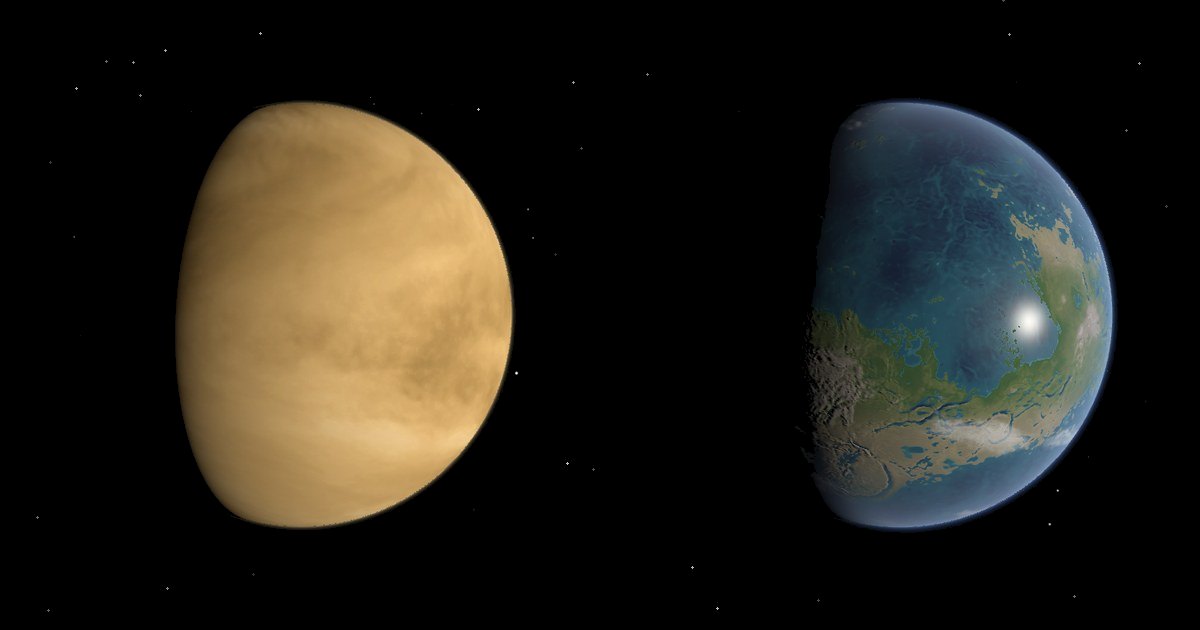
The real Venus, in its real place on its orbit and with its real phase. Peel back the clouds, then remake it into a second Earth and see how much of it would be sea.
 Try it now: free, in your browser
What is under the clouds?
Venus is wrapped in a deck of sulphuric acid droplets 50 to 70 km up that reflects most of the sunlight and hides the ground completely. The clouds race around the planet in about four days, while the planet itself turns once every 243 days, backwards: on Venus the Sun rises in the west, and a day is longer than a year.
Take the clouds away and you still would not see much. The air is 92 times heavier than Earth's, almost all carbon dioxide, and it scatters so much light that from space the ground would be a pale blur. The simulator shows that too. Remove the air as well and you get the view NASA's Magellan probe made with radar between 1990 and 1994: vast lava plains, two highland continents, Ishtar Terra and Aphrodite Terra, and Maxwell Montes, 11 km high.
Turning Venus into a second Earth
Swap the air for Earth's and pour in water, and the heat drains away. Venus is a flat planet: most of it lies within a kilometre or two of the average height, so water spreads a long way. A tenth of Earth's oceans already covers more than half of it, and all of Earth's oceans would drown about 98% of the planet, leaving Ishtar, Aphrodite and a scatter of islands. Sea levels come from Magellan's elevation map.
The slow spin is the other problem. Each place would bake in sunlight for 58 days and then freeze through a 58-day night. Give it a 24-hour day and it gets Earth-like weather: trade winds, a rainy equator and deserts either side of it.
Asteroids on Venus
Venus's thick air is a shield. Stony rocks smaller than about 150 metres burst high above the ground and leave only a dark smudge on the radar map, and nothing smaller than about 1.5 km arrives in one piece, which is why Venus has no lone craters smaller than about 2 km. Big impacts leave bright, lobed debris and, for the largest, a dark parabola of dust that the 100 m/s east-to-west winds lay down hundreds of kilometres to the west. With no oxygen, nothing burns.
How Venus is drawn
Its position comes from JPL's orbital elements for Venus and Earth, accurate to a fraction of a degree, so the phase, distance, morning and evening star dates all match the real sky. Its rotation follows the International Astronomical Union. The ground is the USGS Magellan radar mosaic with Magellan elevation, and the cloud tops are an artist's map by Solar System Scope (CC BY 4.0).
Questions
Why is Venus so hot?
Its air is 96% carbon dioxide and 92 times heavier than Earth's. That traps the heat in a runaway greenhouse effect: the ground is about 464 °C everywhere, day and night, hotter than Mercury and hot enough to melt lead.
What would Venus look like without clouds?
From space, still almost featureless: its thick carbon dioxide air scatters so much light that the ground would be a pale blur. Only radar, like NASA's Magellan, can map it clearly.
Could Venus be terraformed?
In theory it would mean removing about 480 million billion tonnes of carbon dioxide, adding water and speeding up its spin. With Earth's oceans poured in, about 98% of Venus would be under water.
How far away is Venus from Earth?
Between about 38 and 261 million km. It comes closer to Earth than any other planet, every 584 days, when it passes between us and the Sun.
All numbers in the simulator are rough estimates meant to show what could happen, not predictions.