 What If UniverseOpen the simulator
Mars simulator
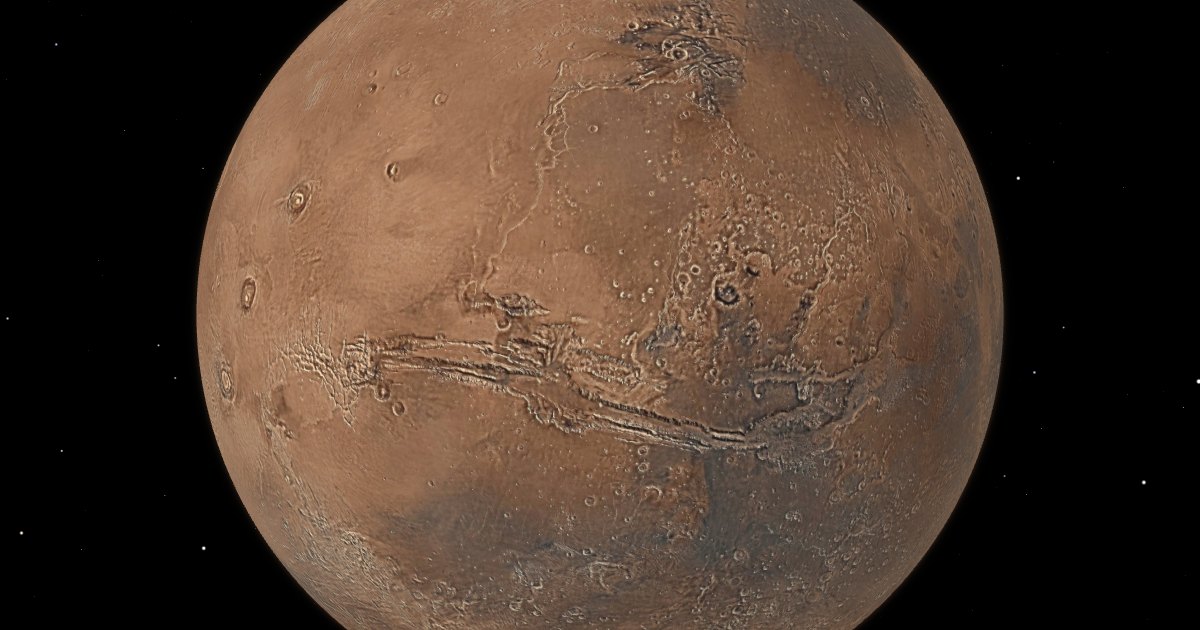
The real Mars, on its real orbit and turning at its real speed, with Phobos and Deimos racing round it. Give it back its ancient oceans, bury it in dust, or see what an asteroid would do.
 Try it now: free, in your browser
The real Mars
The surface is the Viking orbiters' colour mosaic of the whole planet, and up close the simulator streams it at full resolution, about 230 m to a pixel, from the US Geological Survey. Heights come from the laser altimeter on Mars Global Surveyor, which measured the planet to within a few metres: Olympus Mons stands 21 km above Mars's "sea level", and the floor of the Hellas basin lies 8 km below it.
Mars's position comes from JPL's orbital elements and its spin from the International Astronomical Union, so oppositions, close approaches and the times it hides behind the Sun all match the real sky. A day on Mars, a sol, lasts 24 hours 40 minutes.
Oceans on Mars
Three to four billion years ago Mars had rivers, deltas and lakes, and many scientists think an ocean filled its northern lowlands. Pour water back in and the sea level follows the real terrain: melting the polar caps (enough for a layer about 20 m deep over the planet) only floods the deepest basins, while a layer 130 m deep fills the north up to the old Deuteronilus shoreline and 550 m reaches the older Arabia shoreline. All of Earth's oceans would leave only the giant volcanoes and the highest southern highlands above water.
Keeping that water liquid would take air about as thick as Earth's and 70 °C warmer. Mars has nowhere near enough carbon dioxide of its own: melting both caps would thicken its air to only about 2% of Earth's. And with no magnetic field to shield it, the solar wind would slowly strip any new air away again.
Dust storms
Mars's air is about 1% as thick as Earth's, yet it lifts enough dust to hide the whole planet. Storms start in the low basins in southern spring and summer, when Mars is closest to the Sun, and every few Martian years one spreads round the globe. In 2018 a planet-wide storm blocked so much sunlight that the Opportunity rover could no longer charge its batteries, ending its 15-year mission.
Asteroids on Mars
The thin air stops only the smallest rocks, so Mars collects fresh craters every year. Orbiters have photographed hundreds, each ringed by a dark blast zone where the impact swept the bright dust off the ground. Rocks hit at about 10 km/s, half Earth's typical speed. Craters from about 5 to 60 km across often have ejecta that flowed like mud and stopped in a low ridge, a sign of ice in the ground. A rock a few hundred kilometres across would leave a basin like Hellas, and one about 4,000 km across would blow the planet apart.
Nuking Mars
In air 1% as thick as Earth's, a nuclear bomb behaves very differently. The blast wave is weak and fades fast: a one-megaton bomb wrecks buildings out to about 3.5 km instead of 7 km. There is no oxygen, so nothing burns, and no rain to wash fallout out of the sky. Its radiation, with so little air to soak it up, stays deadly much farther away than on Earth.
In 2015 Elon Musk suggested warming Mars by setting off nuclear bombs over its polar caps. Try it with 10,000 one-megaton bombs: the flashes are spectacular, but they free so little carbon dioxide that the air gets about 0.1% thicker. Even freeing all the carbon dioxide buried in the south cap would take millions of bombs and would only roughly double Mars's thin air.
Phobos and Deimos
Phobos, 27 km long, orbits only 6,000 km above the ground, so fast that it rises in the west and sets in the east twice a day. Tides drag it a little lower every year: in 30 to 50 million years it will be torn apart into a ring of rubble or crash. The simulator lets you do both now, and fly out to look at Phobos with Mars behind it.
Questions
Could Mars be terraformed?
Not with what Mars has. Its ice caps and soil hold too little carbon dioxide to make the air thick and warm enough for liquid water, and without a magnetic field the solar wind strips the air away. It would need gases brought from elsewhere and continual topping up.
How much of Mars would be ocean?
It depends on the water. Melting its polar caps would only fill the deepest basins; an ancient-style northern ocean 130 m deep on average would cover about a fifth of the planet; Earth's oceans would drown all but the volcanoes and the highest highlands.
How far away is Mars from Earth?
Between about 56 and 401 million km. It is closest around opposition, every 26 months, when Earth passes between Mars and the Sun.
Would nuking Mars make it warmer?
Not noticeably. 10,000 one-megaton bombs over the poles would free only enough carbon dioxide to thicken the air by about 0.1%. Mars does not have enough carbon dioxide within reach to give it Earth-like air, however much of it you release.
Will Phobos crash into Mars?
Probably not in one piece. It is spiralling inward by about 2 m a century and in 30 to 50 million years Mars's tides will pull it apart into a ring, which will slowly rain down onto the planet.
All numbers in the simulator are rough estimates meant to show what could happen, not predictions.