 What If UniverseOpen the simulator
Moon simulator
The real Moon, where it is right now, with its real phase. Move it, hit it or tear it apart, and see what each would do to Earth.
 Try it now: free, in your browser
What if the Moon were closer?
Tides grow with the cube of how close the Moon is. Bring it to half its distance and the tides are eight times higher: about 8 metres instead of 1, flooding the homes of hundreds of millions of people twice a day. A month would last under ten days, the Moon would look twice as wide and total solar eclipses would become common.
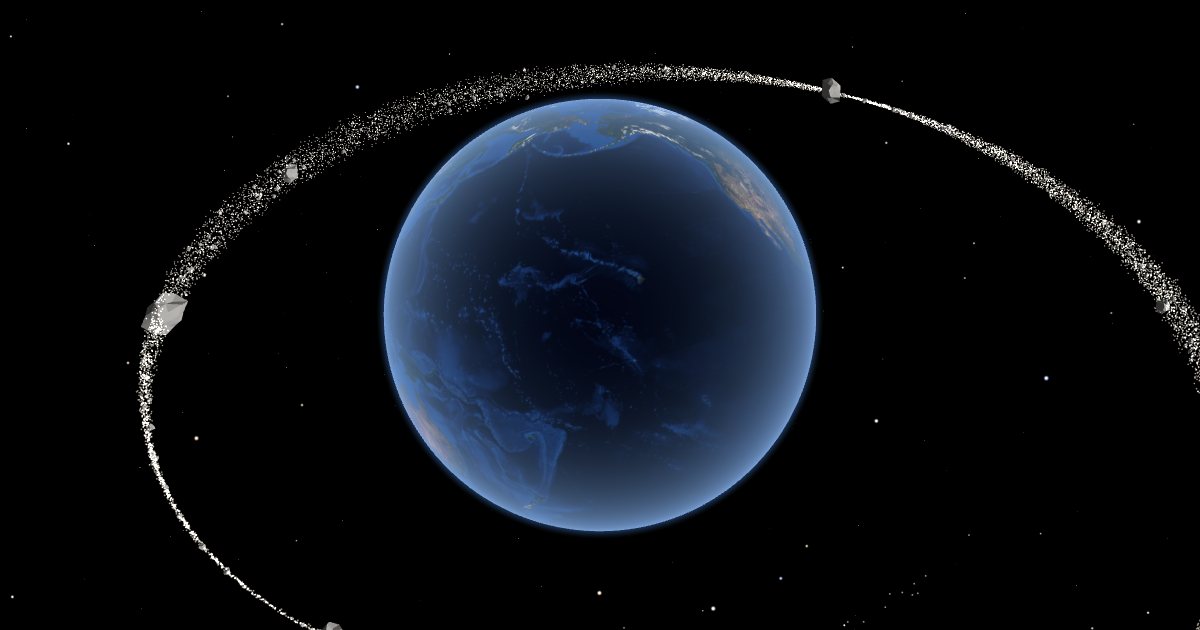
At about 42,000 km it would circle once a day, as fast as Earth turns. It would hang still over one side of the planet, and the sea would pile up hundreds of metres beneath it for good. Closer than about 18,500 km, the Roche limit, Earth's pull tears it apart into a ring of rock.
Move it the other way and the tides fade, the month stretches out, and past roughly a million and a half kilometres the Sun takes the Moon away altogether.
Nuking the Moon, and destroying it
In 1958 the US Air Force studied a plan, Project A119, to set off a small nuclear bomb on the Moon where people on Earth could see the flash. There is no air on the Moon, so there is no blast wave, no fireball and no mushroom cloud: just a flash, a crater and rock thrown in perfect arcs that lands far away. Even the 50 megaton Tsar Bomba would leave a crater barely a kilometre wide.
Blowing the Moon apart takes about 1.2 × 10²⁹ joules, the energy needed to overcome its own gravity. That is roughly 600 billion Tsar Bombas, or a Ceres-sized asteroid 940 km across hitting at 20 km/s. The simulator follows every piece under Earth's gravity: the rubble spreads along the old orbit, and pieces on paths that cross Earth's fall at 11 km/s.
Eclipses and how the Moon is drawn
The Moon's position follows the lunar theory in Jean Meeus' Astronomical Algorithms, accurate enough that the eclipse finder matches NASA's eclipse predictions to within about a minute. Its surface is NASA's Lunar Reconnaissance Orbiter colour mosaic with relief from the LOLA laser altimeter, and craters made by your impacts stay where they land.
Questions
What would happen if the Moon was closer to Earth?
Tides would be much higher: eight times higher at half the distance, more than sixty times at a quarter. Coasts would flood twice a day, the extra squeeze on the crust would set off more large earthquakes, and a month would be much shorter.
Could nukes destroy the Moon?
No. Every nuclear weapon on Earth together releases less than a billionth of the energy needed. The biggest bomb ever tested would leave a crater about a kilometre across.
What would happen if the Moon disappeared?
Tides would shrink to about a third, coming only from the Sun. Nights would be darker, there would be no more eclipses, and over millions of years Earth's tilt would wobble more, making the climate less stable.
What is the Roche limit?
The distance at which a planet's pull on the near side of a moon outweighs the moon's own gravity. For the Moon and Earth it is about 18,500 km; closer than that the Moon would be torn apart into a ring.
All numbers in the simulator are rough estimates meant to show what could happen, not predictions.